
Taxes and fiscality
IBI, SUMA and Basura in Spain: What Property Owners Need to Pay
Last updated on 28.08.2026Buying a property in Spain involves more than the initial purchase price and transaction costs. Once you become an owner, there are also a number of recurring local taxes and charges to consider.
Three terms that often cause confusion among international property owners are IBI, SUMA and basura.
They are sometimes used interchangeably, particularly on the Costa Blanca, but they do not mean the same thing.
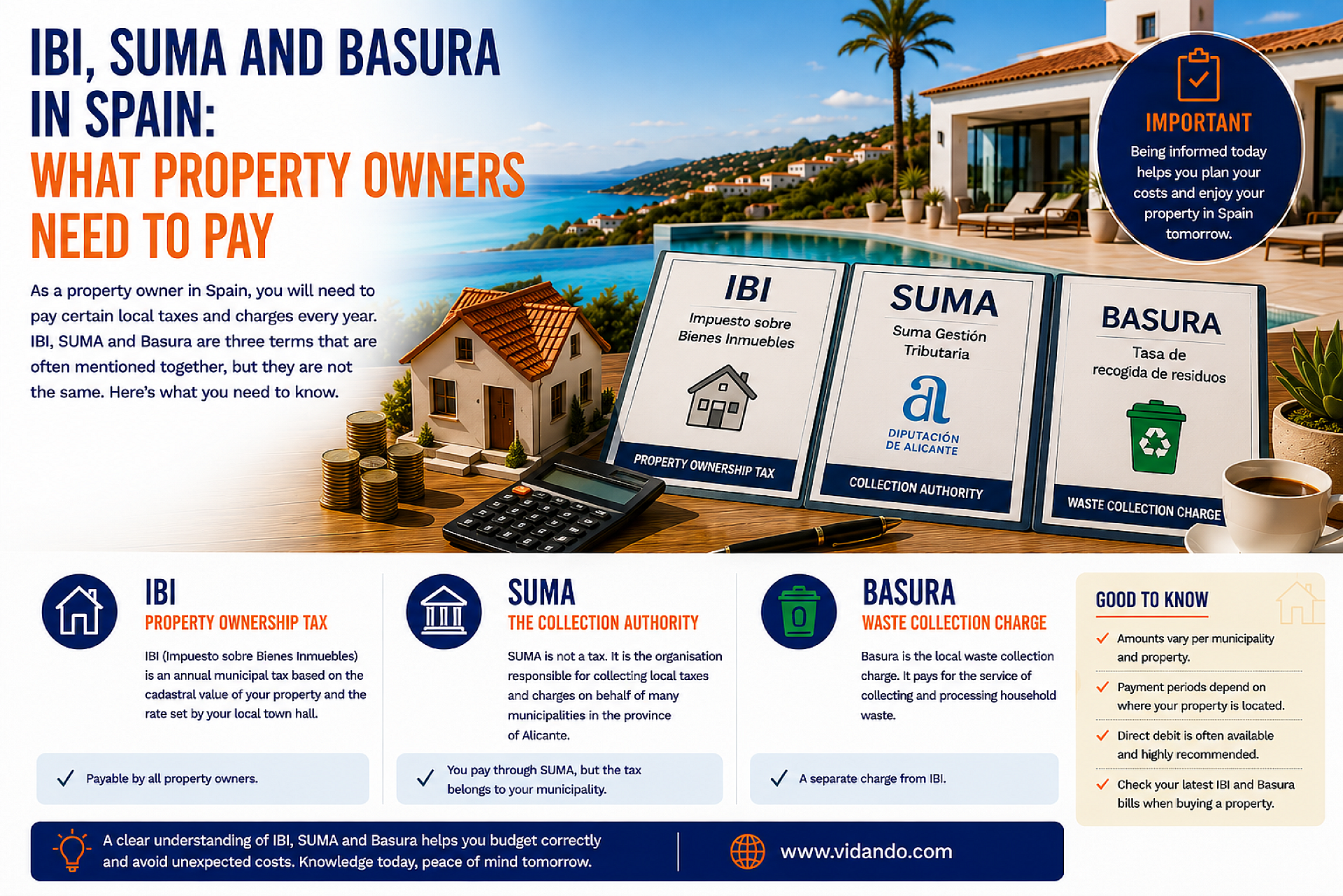
In simple terms:
- IBI is the annual municipal property tax.
- SUMA is the organisation that collects various local taxes and charges on behalf of many municipalities in the province of Alicante.
- Basura is the local waste collection charge.
Understanding the difference is particularly useful for foreign property owners on the Costa Blanca, as several payments may be collected through the same organisation.
What is IBI in Spain?
IBI stands for Impuesto sobre Bienes Inmuebles.
It is an annual municipal tax associated with owning real estate in Spain. Owners of houses, apartments, villas, garages and other types of real estate may therefore be required to pay IBI each year.
The amount is calculated using factors that include the property's valor catastral, or cadastral value, together with the applicable rate set by the municipality.
As a result, IBI is not the same for every property or every municipality.
The annual IBI bill for a villa in Jávea, for example, may be very different from that of a property in Torrevieja, Alicante or another municipality.
When buying a resale property in Spain, it is therefore useful to ask for a copy of the property's most recent IBI bill.
So what exactly is SUMA?
This is where many international buyers and owners become confused.
SUMA is not a separate property tax.
Suma Gestión Tributaria is a tax collection and management organisation operating for municipalities in the province of Alicante.
Many municipalities delegate the collection of certain local taxes and charges to SUMA.
Depending on the municipality, SUMA may therefore collect payments relating to:
- IBI;
- waste collection charges;
- certain municipal taxes and fees;
- vehicle-related taxes;
- other local charges.
If you see SUMA appearing on your Spanish bank account, it does not necessarily mean that you are paying a tax called SUMA.
You could, for example, simply be paying your IBI through SUMA.
A simple example
Imagine you own an apartment on the Costa Blanca.
Your annual charges could hypothetically include:
- IBI: €600
- Basura: €180
Depending on the municipality, both payments could be collected through SUMA.
Your bank statement may therefore show SUMA as the collecting authority even though you are actually paying two different charges.
That distinction is important.
What is the basura tax in Spain?
Basura literally means rubbish or waste.
The tasa de basura is generally a municipal charge associated with the collection and treatment of household waste.
It is therefore different from IBI.
IBI relates to the ownership of real estate, while basura relates to a municipal service provided in connection with waste collection and processing.
How the charge is calculated and how much you pay depends on the municipality.
Is basura paid separately from IBI?
Yes. IBI and basura are separate charges.
This can be confusing because both may be collected by the same organisation.
For example, if SUMA collects both charges in your municipality, you may see several SUMA payments on your bank account during the year.
That does not mean they are all the same tax.
A useful way to remember the difference is:
- IBI = property ownership tax
- Basura = waste collection charge
- SUMA = collecting authority in many Alicante municipalities
When do I have to pay IBI and basura?
There is no single payment date for every property owner in Spain.
Payment periods depend on the municipality and can also change from one year to another.
In many municipalities in the province of Alicante, SUMA publishes an annual calendar showing the voluntary payment periods for the taxes and charges it manages.
Other municipalities may have their own collection arrangements.
For this reason, property owners should always check the current payment calendar applicable to the municipality where the property is located.
Can I pay IBI and basura by direct debit?
In many cases, yes.
Setting up a direct debit from a Spanish bank account can be particularly convenient for international owners who do not live in Spain throughout the year.
It reduces the risk of overlooking a payment deadline while abroad.
After purchasing a property, it is therefore worth checking that the appropriate tax records, contact details and bank details have been updated.
What happens if I pay IBI or basura late?
Failing to pay within the applicable period can result in surcharges and collection costs.
International owners should therefore avoid assuming that a bill will always arrive automatically at their home address abroad.
After completion, make sure you know:
- which local taxes apply;
- who collects them;
- when they are due;
- how they will be paid;
- whether a direct debit has been activated.
A small amount of organisation after the purchase can prevent unnecessary problems later.
What happens to IBI when a property is sold?
When buying a resale property in Spain, the property's tax position should form part of the checks carried out before completion.
It is sensible to establish whether previous IBI bills have been paid and whether there are any outstanding local liabilities connected with the property.
Recent payment receipts can be requested and the relevant legal adviser can verify the situation as part of the due diligence process.
The purchase contract should also make clear how relevant costs between buyer and seller are being handled.
And what about outstanding basura charges?
The position regarding municipal waste charges should also be checked when purchasing a resale property.
The precise rules can depend on the municipality and the property.
Rather than assuming that everything is automatically settled when the title deed is signed, buyers should include relevant local charges in the administrative and legal checks carried out before completion.
How much do IBI and basura cost in Spain?
There is no reliable single figure.
The amount can vary according to factors such as:
- municipality;
- cadastral value;
- type of property;
- size;
- use of the property;
- applicable local rates and calculation methods.
A luxury villa can therefore have a very different annual IBI bill from a smaller apartment.
This is why international buyers should look beyond the purchase price when comparing properties.
Ask about the property's annual ownership costs as well.
These can include:
IBI + basura + community fees + insurance + utilities + maintenance + applicable tax obligations.
IBI, SUMA and basura at a glance
| Term | What is it? | What does it relate to? |
|---|---|---|
| IBI | Municipal property tax | Ownership of real estate |
| SUMA | Tax collection organisation | Collects various local taxes and charges for many Alicante municipalities |
| Basura | Municipal waste charge | Waste collection and treatment |
The most important misunderstanding to avoid is therefore:
SUMA and IBI are not the same thing.
SUMA may collect your IBI, but it may also collect other local charges such as basura.
Buying a property on the Costa Blanca? Ask about the annual costs
Before purchasing a property in Spain, ask for a clear overview of the recurring costs associated with owning it.
For a resale property, this could include requesting information about:
- the latest IBI bill;
- the latest basura charge;
- community fees;
- utility costs;
- insurance;
- other relevant local charges.
This gives you a better understanding not only of what the property costs to buy, but also what it may cost to own each year.
At Vidando Estates, we believe this type of information is part of making a transparent and well-informed property decision.
Finding the right property is important.
Understanding what you are buying — and the ongoing costs that come with it — is just as important.
FAQ - Frequently asked questions about IBI, SUMA and Basura in Spain: What Property Owners Need to Pay
1. What is the difference between IBI and SUMA in Spain?
IBI (Impuesto sobre Bienes Inmuebles) is the annual municipal property tax payable on real estate in Spain.
SUMA, on the other hand, is not a property tax. Suma Gestión Tributaria is the tax collection authority used by many municipalities in the province of Alicante to manage and collect local taxes and charges.
This means you may pay your IBI through SUMA, but the two terms do not mean the same thing.
2. What is the basura tax in Spain?
Basura refers to the local waste collection charge.
It helps fund municipal services related to the collection and treatment of household waste. It is separate from IBI, although both charges may sometimes be collected by the same authority.
The amount and method of calculation can vary between municipalities.
3. Do property owners in Spain have to pay IBI every year?
Generally, property owners should expect IBI to be an annual ownership cost.
The amount depends on factors including the property's cadastral value (valor catastral) and the rate applied by the relevant municipality.
For this reason, two properties with similar market values can have different IBI bills.
4. How much is IBI on a property on the Costa Blanca?
There is no single Costa Blanca IBI rate.
The amount depends on the municipality, cadastral value of the property and the applicable local tax rate.
When considering a villa or apartment on the Costa Blanca, ask for a copy of the most recent IBI bill rather than relying on a general estimate.
5. Is basura included in the IBI property tax?
No. IBI and basura are separate charges.
IBI relates to ownership of the property, while basura relates to municipal waste services.
They may appear to be connected when the same authority collects both payments, but they remain distinct charges.
6. When do I have to pay IBI and basura in Spain?
Payment periods depend on the municipality and can change from year to year.
If your property is located in the province of Alicante, SUMA may manage the collection calendar on behalf of your municipality. Some municipalities manage their own collection.
It is therefore important to check the specific annual payment calendar for the municipality where your property is located.
7. Can I pay IBI and basura by direct debit from my bank account?
In many cases, yes.
Setting up a direct debit is particularly convenient for international owners who do not live permanently in Spain.
It reduces the risk of overlooking a payment deadline while you are abroad. After buying a property, check that the correct bank and contact details have been registered.
8. What happens if I don't pay my IBI or basura on time?
Late payment can result in surcharges and collection costs, depending on when the outstanding amount is settled and the applicable procedure.
For foreign owners, it is therefore important not to assume that a bill will automatically reach an overseas address.
Checking your tax position and arranging direct debit where appropriate can help prevent problems.
9. Can a property in Spain have outstanding IBI or basura debts when I buy it?
Outstanding local taxes or charges should be considered as part of the checks carried out when purchasing a resale property.
Ask for recent payment evidence and have the relevant legal or professional adviser verify the property's tax and administrative position before completion.
This is one reason why proper due diligence when buying a resale property in Spain is so important.
10. What other annual costs should I budget for when owning property in Spain?
IBI and basura are only part of the cost of owning Spanish property.
Depending on the property and your personal situation, you may also need to budget for:
- community fees;
- property insurance;
- electricity and water;
- maintenance and repairs;
- pool and garden maintenance;
- other applicable local charges;
- tax obligations associated with owning property in Spain.
When buying a property, therefore, don't only ask “What does it cost to buy?” Also ask: “What will this property cost me each year to own?”